Small Quantity and Commercial Quantity Under the NDPS Act: A Comprehensive Legal Guide
Master the NDPS Act: Small vs. Commercial Quantity charts, punishment tiers, bail rules, and key Supreme Court judgments like Hira Singh. Read now!
The Narcotic Drugs and Psychotropic Substances Act, 1985 (NDPS Act), is one of the most stringent pieces of legislation in the Indian penal system. Designed to curb the menace of drug trafficking, the Act adopts a “graded” approach to punishment. At the heart of this framework lies the classification of substances into small quantity, intermediate quantity, and commercial quantity.
For legal professionals, law students, and the general public, understanding these distinctions is critical, as the quantity of the substance seized determines everything from the eligibility for bail to the severity of the prison sentence.
1. The Statutory Framework: Categorizing Quantities
The NDPS Act does not define specific weights within its main text. Instead, it delegates this power to the Central Government. Under Section 2(viia) and Section 2(xxiiia), “small” and “commercial” quantities are defined as those specified by the government via notification.
The primary reference for these weights is Notification S.O. 1055(E) dated October 19, 2001. This notification provides a table for 239 substances, specifying what constitutes a small or commercial quantity for each.
The Three Tiers of Punishment
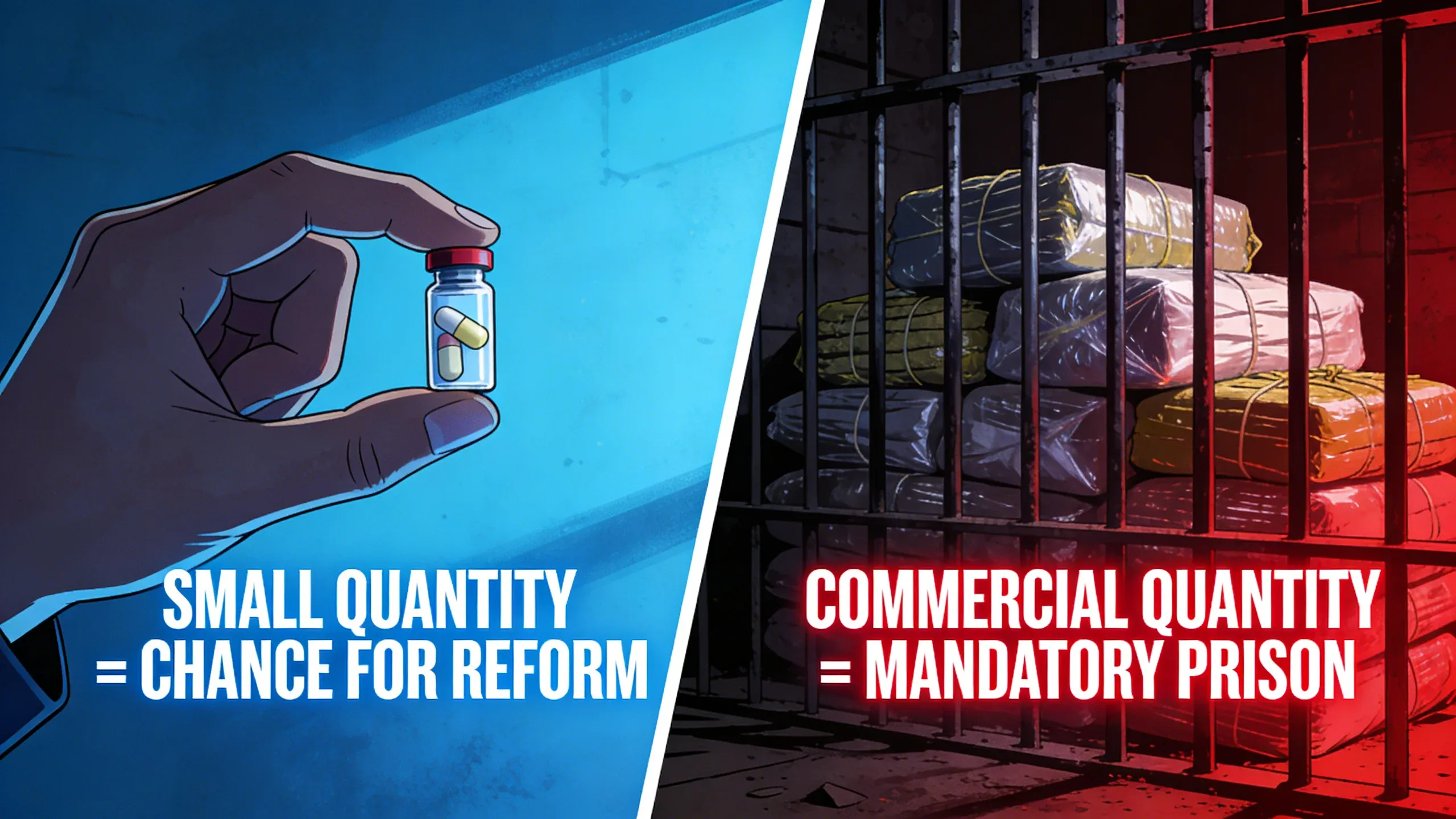
- Small Quantity: Focuses on reform. Punishment is generally up to 1 year of rigorous imprisonment (RI), a fine up to ₹10,000, or both.
- Lesser than Commercial but Greater than Small (Intermediate): Punishment extends up to 10 years of RI and a fine up to ₹1 lakh.
- Commercial Quantity: Aimed at traffickers. Punishment involves a mandatory minimum of 10 years of RI, extending to 20 years, and a fine of ₹1 lakh to ₹2 lakh.
2. Deep Dive: Punishment for Commercial Quantity
When a seizure is classified as a “commercial quantity,” the legal landscape shifts dramatically against the accused.
Section 20(b)(ii)(C) NDPS Act: Cannabis (Ganja)
This section penalizes the production, possession, sale, and transport of cannabis. If the contravention involves a commercial quantity of ganja, the court must award at least 10 years of RI.
- Commercial Quantity of Ganja: 20 Kilograms.
- Small Quantity of Ganja: 1 Kilogram.
Section 21(c) NDPS Act: Manufactured Drugs
This section applies to manufactured drugs like Heroin (Diacetylmorphine), Cocaine, and Morphine.
- Heroin Commercial Quantity: 250 grams.
- Section 21(c) mandates the 10-to-20-year sentencing bracket for commercial amounts.
Section 22(c) NDPS Act: Psychotropic Substances
This section covers chemical substances like LSD, MDMA, Alprazolam, and Methamphetamine.
- 22(c) NDPS Act is triggered when the psychotropic substance seized exceeds the commercial threshold (e.g., 2 grams for LSD or 50 grams for Methamphetamine).
3. The “Hira Singh” Revolution: Calculating Total Weight
One of the most litigated aspects of the NDPS Act was whether the “quantity” refers to the pure drug content or the entire weight of the mixture.
In the past, the E. Micheal Raj (2008) case held that only the pure drug content should be counted. However, this was overturned by the Supreme Court in the landmark case of Hira Singh v. Union of India (2020).
Key Takeaways from Hira Singh (2020):
- Inclusion of Neutral Substances: The Court ruled that if a drug is mixed with a neutral substance (like sugar, caffeine, or milk powder), the entire weight of the mixture must be considered to determine the quantity.
- Rationale: Drug traffickers rarely sell pure drugs. Heroin is often “cut” to increase volume. Excluding the neutral substance would allow major traffickers to escape the “commercial quantity” bracket simply by adulterating their product.
- Note 4 of the 2009 Notification: The Court upheld Note 4, which states that the quantity shown in the table applies to the entire mixture/solution and not just the pure drug.
4. NDPS Act Quantity Chart: Small vs. Commercial
Below is a reference chart for common substances based on Notification S.O. 1055(E) and judicial references.
| Substance | Small Quantity | Commercial Quantity |
|---|---|---|
| Heroin | 5 grams | 250 grams |
| Ganja | 1,000 grams (1 kg) | 20,000 grams (20 kg) |
| Charas (Hashish) | 100 grams | 1,000 grams (1 kg) |
| Opium | 25 grams | 2,500 grams (2.5 kg) |
| Cocaine | 2 grams | 100 grams |
| LSD | 0.002 grams (2mg) | 0.1 gram (100mg) |
| Alprazolam | 5 grams | 100 grams |
| Amphetamine | 2 grams | 50 grams |
| MDMA (Ecstasy) | 0.5 grams | 10 grams |
| Codeine | 10 grams | 1,000 grams (1 kg) |
5. List of Psychotropic Substances under the NDPS Act
The Schedule to the NDPS Act is a dynamic list. Substances are added as new synthetic drugs emerge. Currently, the list includes:
- Stimulants: Amphetamine, Methamphetamine, Mephedrone (Meow Meow).
- Depressants/Sedatives: Alprazolam, Diazepam, Nitrazepam, Methaqualone.
- Hallucinogens: LSD, Mescaline, Phencyclidine (PCP).
- Analgesics: Tramadol (added in 2018), Ketamine.
- Synthetic Cannabinoids: THC and its variants.
The inclusion of Tramadol and Mephedrone in recent years highlights the government’s crackdown on the “pharma-drug” abuse epidemic.
6. Procedural Safeguards: The Defense’s Shield
Because the NDPS Act carries such harsh penalties, the law provides mandatory procedural safeguards. Any lapse by the police can lead to the acquittal of the accused, even in commercial quantity cases.
Section 50: The Right to a Gazetted Officer
When a person is being searched (personal search), the officer must inform them of their right to be searched in the presence of a Gazetted Officer or a Magistrate.
- State of Punjab v. Baldev Singh (1999): The Constitution Bench held that Section 50 is mandatory. Failure to inform the accused of this right vitiates the recovery.
- Limitation: Section 50 applies only to “personal search” (pockets, body). It does not apply to the search of a vehicle or a bag carried by the person (Baljinder Singh Case).
Section 42: Search and Seizure without Warrant
If an officer receives information about drugs in a building or conveyance, they must record it in writing and send a copy to their superior officer within 72 hours. Failure to comply with this “writing” and “reporting” requirement can be fatal to the prosecution’s case.
Section 67 and the Toofan Singh Ruling
In Toofan Singh v. State of Tamil Nadu (2020), the Supreme Court delivered a massive blow to the prosecution. It held that:
- NDPS officers are “police officers.”
- Confessional statements recorded under Section 67 are inadmissible in evidence.
- An accused cannot be convicted solely based on a confession made to an NDPS officer.
7. Bail in Commercial Quantity Cases: The Section 37 Hurdle
For small quantities, bail is the rule. For commercial quantities, bail is a rare exception due to Section 37.
The Twin Conditions for Bail:
- The Public Prosecutor must be given an opportunity to oppose the bail.
- The Court must be satisfied that there are reasonable grounds to believe the accused is not guilty and is not likely to commit an offence while on bail.
This creates a “reverse burden” where the accused must effectively prove their innocence at the bail stage, making it one of the hardest provisions to overcome in Indian law.
8. IRAC Analysis: A Hypothetical Case Study
Issue: An individual is arrested with 400 grams of a powder that tests positive for Heroin. However, lab reports show the pure Heroin content is only 10 grams, while the remaining 390 grams is powdered sugar. Does this constitute a “commercial quantity” under Section 21(c)?
Rule:
- Section 21(c): Deals with commercial quantities of manufactured drugs.
- Notification S.O. 1055(E): Heroin commercial quantity starts at 250 grams.
- Hira Singh v. Union of India (2020): Total weight of the mixture (including neutral substances) determines the category.
Analysis: Prior to 2020, based on E. Micheal Raj, the quantity would have been 10 grams (Intermediate). However, following the Hira Singh verdict, the court must look at the “mixture.” Since the total weight of the powder containing Heroin is 400 grams, it exceeds the 250-gram threshold for Heroin.
Conclusion: The accused will be charged under Section 21(c) for possession of a commercial quantity. The mandatory minimum sentence of 10 years will apply, and the strict bail conditions of Section 37 will be triggered.
9. Frequently Asked Questions (FAQs)
Q1: What is the commercial quantity of Ganja? The commercial quantity of Ganja is 20 kilograms. Possession of any amount above this triggers Section 20(b)(ii)(C).
Q2: Can I get bail if caught with a commercial quantity? Bail is extremely difficult due to Section 37. You must convince the court that there are reasonable grounds to believe you are not guilty. Procedural lapses (like violation of Section 50) are the most common grounds for bail in such cases.
Q3: Is Tramadol a psychotropic substance? Yes, Tramadol was added to the Schedule of the NDPS Act in 2018. The commercial quantity for Tramadol is 250 grams.
Q4: Does the weight of the packaging/plastic bag count toward the drug weight? No. While “neutral substances” mixed with the drug count, the weight of the external container or packaging material is generally excluded.
Q5: What happens if the police don’t follow Section 50? If the search was of your person and the police failed to inform you of your right to a Gazetted Officer, the evidence (the drug) may be deemed inadmissible, often leading to an acquittal.
10. Conclusion
The NDPS Act’s distinction between small and commercial quantities reflects the legislative intent to distinguish between victims of drug abuse and the “sharks” of the drug trade. While the Hira Singh judgment has made the law much tougher by including neutral substances in weight calculations, the Toofan Singh and Baldev Singh judgments ensure that the police must play strictly by the rules.
In commercial quantity cases, the stakes are a decade of one’s life. Therefore, a meticulous understanding of the NDPS Act quantity chart and the latest Supreme Court precedents is the only path to a robust legal defense.